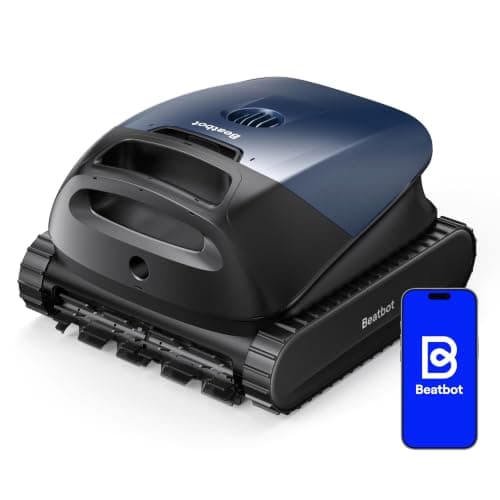
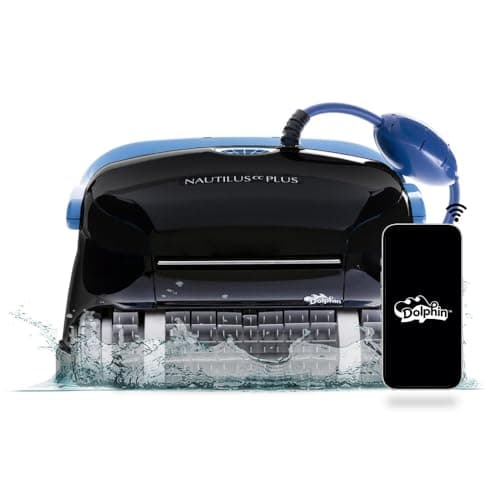
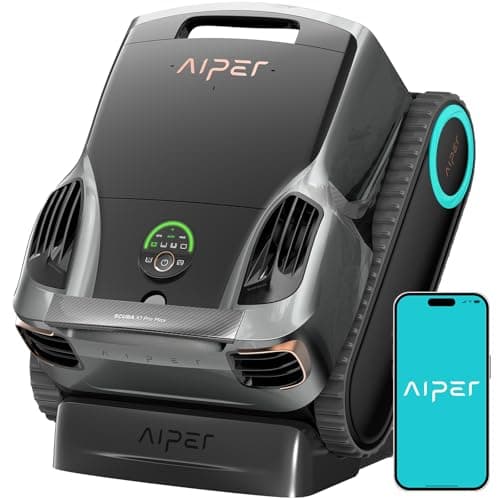
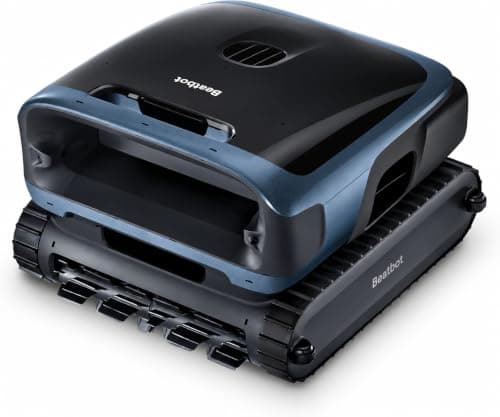
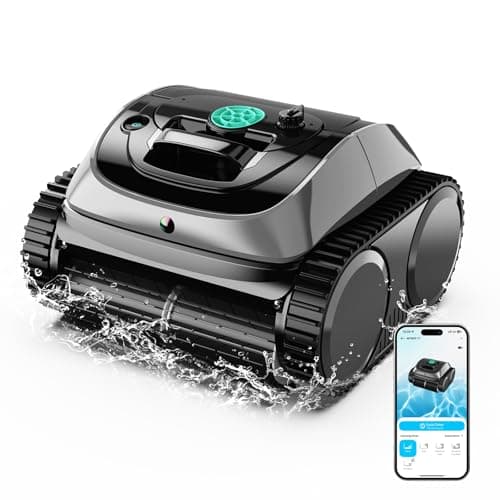
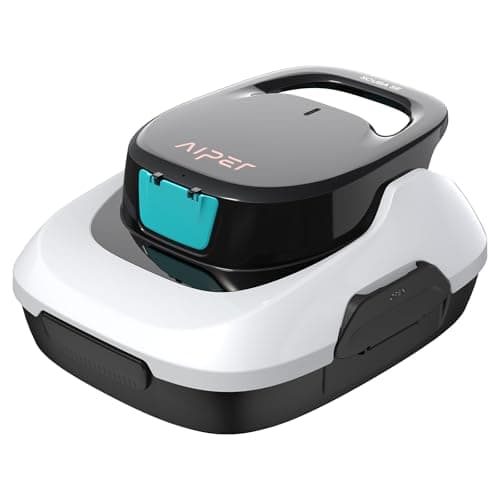
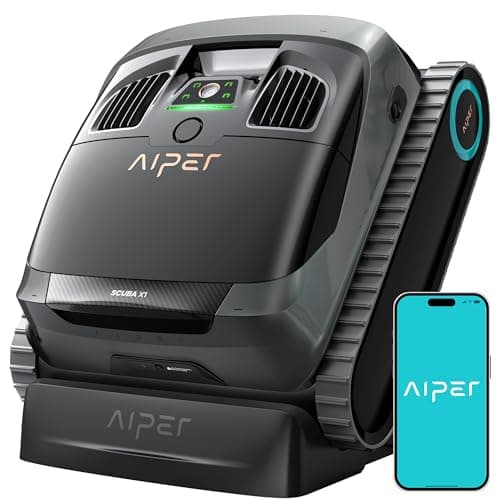
Almost every “best robotic pool cleaner” list ranks machines by price. That is the wrong axis. A $2,300 flagship on a 20-foot rectangle is worse value than a $130 floor robot, and a $130 floor robot in a 40-foot pool with a pine canopy is a waste of money twice over. Four specifications decide whether a machine fits your pool, and none of them is the price.
The four specs that decide it
1. Rated pool size, in square feet or length
This is the hard gate. Manufacturers publish a rated area (Aiper, Beatbot, WYBOT) or a rated length (Maytronics’ Dolphin line). Exceed it and the machine does not fail dramatically — it simply never finishes, which looks like “it misses the deep end” and gets blamed on navigation. Measure your pool before you read another feature list. A 16 × 32 ft rectangle is 512 sq ft of floor; add the walls and you are asking a robot to cover roughly 900 sq ft of surface.
2. Coverage: floor, walls, waterline, surface
These are four separate capabilities and manufacturers list them separately for a reason. A floor-only robot will never touch the grease line at your waterline. A wall-climbing robot reaches the waterline but usually smears it rather than scrubbing it. Only machines with an explicit waterline pass — the Beatbot AquaSense 2’s double pass, the Dolphin CC Supreme’s dedicated brush, the horizontal pass on the Aiper S1 Pro and WYBOT S2 — actually shift it. Surface skimming is a fifth capability and exists on only three machines here.
3. Filter rating, in microns
The single most under-read spec in the category. A 180-micron basket catches leaves and passes sand, pollen and dead algae straight back into the water. A 3-micron filter catches all of it and clogs in a leafy pool within twenty minutes. There is no universally correct answer — there is only the answer that matches your debris, which is why this site sorts by debris first. Note which machines publish a figure at all: Aiper publishes 3 micron on the X1 Pro Max and Obsidian, Beatbot publishes 150 micron on the Sora 10, WYBOT publishes a 10-micron layer on the C2. Several popular models publish nothing, and we say so on their pages rather than guessing.
4. Power architecture: cordless or corded
Cordless robots have no cable to tangle and no power supply to site. They also have a battery, and a lithium pack cycled hard in 85°F water through four summers is the most common reason a three-year-old robot stops working. Corded robots — essentially the entire Maytronics Dolphin line, plus Hayward and the Polaris VRX — have a floating cable and a transformer that needs a dry GFCI-protected spot, and they routinely outlast two cordless machines. The full cordless-versus-corded comparison works through the trade in detail.
How we picked
Every machine on this page is currently sold on Amazon, and every figure in its spec table is attributed to the manufacturer or to the retailer listing. Scores come from a published five-metric rubric applied to those figures. We do not physically test pool robots and nothing on this site implies that we do — what we do instead is show our arithmetic, name who each machine is wrong for, and refuse to print a number we cannot source.
Common mistakes buyers make
- Buying on suction GPH alone. 8,500 GPH through a 180-micron basket removes less fine debris than 4,000 GPH through a 3-micron filter. Flow and filtration multiply; they do not substitute.
- Buying a flagship for a simple rectangle. Mapping, cameras and debris detection earn their price on freeform, multi-level and beach-entry pools. On a rectangle, a pattern-navigating robot covers the floor just as well for a third of the money.
- Ignoring weight. You lift this thing out of the water every run. A 29 lb robot and a 19 lb robot are different purchases, and the heavy one gets used less. Budget for a caddy if the machine is over about 20 lb.
- Treating a skimmer as a cleaner. A solar skimmer is an excellent second machine and a terrible only machine. See the skimmer roundup for where it does fit.
- Forgetting the consumables. Filters, brushes and tracks are the running cost. A Dolphin’s ultra-fine cartridges are about $26 for four; some cordless flagships want $100 for one basket. The parts section has the real figures.
What to look for beyond the spec sheet
Two things that do not appear in any feature list but decide how the purchase feels in year three. First, parts availability: Maytronics spares are stocked by every pool retailer in the country, third-party Aiper and WYBOT batteries already exist, and some brands have nothing. Second, retrieval: “surface parking” and “tap-to-retrieve” sound like marketing until the alternative is swimming to the deep end for a 25 lb robot twice a week.