The key fact: it is independent of your pool
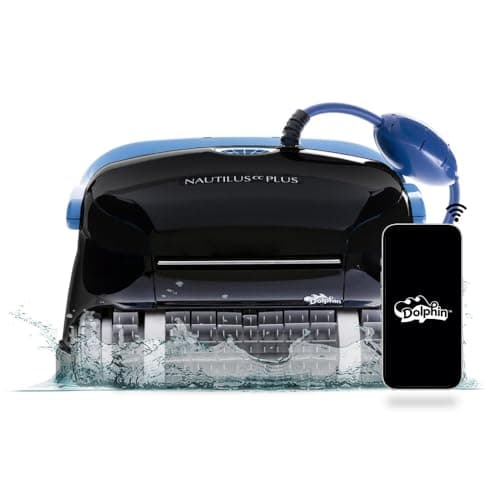
This is what separates a robot from every other cleaner. A suction cleaner is driven by your pool pump and sends debris into your filter. A pressure-side cleaner is driven by return pressure and bags debris. A robot has its own motor, its own pump and its own filter, and runs with your pool pump switched off.
Everything else follows from that: the robotic-versus-suction comparison works through the consequences.
Subsystem 1: the pump and intake
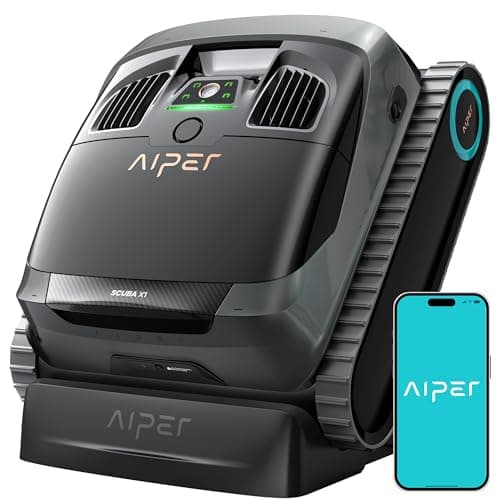
An impeller driven by an electric motor pulls water in through an intake in the base, through the filter, and out through an exhaust. The spec you see for this is suction, in GPH — 1,820 GPH on a budget machine, 6,600-6,800 on the mid-to-upper range, 8,500 on the Aiper X1 Pro Max.
GPH alone is a poor predictor of cleaning, because it describes how much water moves, not what gets caught. High flow through a coarse filter removes less fine debris than modest flow through a fine one.
Subsystem 2: the filter
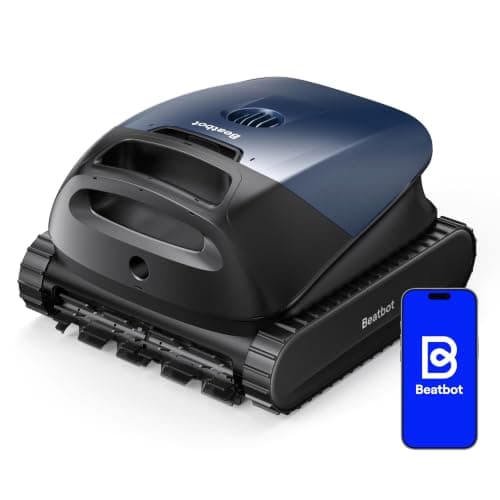
The water passes through a basket, cartridge or cloth whose mesh determines what it retains. The spec is micron rating: 180 micron on standard baskets, 150 on the Beatbot Sora 10, a 10-micron layer on the WYBOT C2, 3 micron on Aiper’s Obsidian and X1 Pro Max.
Finer is not better in the abstract — a 3-micron filter blinds within minutes in leaf litter. Match the rating to your debris. The filtration explainer goes into this properly.
Subsystem 3: the drive
Either wheels or continuous tracks, driven by one or more motors. Tracks grip better on slick surfaces (vinyl liner, fiberglass gelcoat) and crawl over obstacles more reliably. Wheels are cheaper and roll faster.
Multi-motor machines separate drive from suction — Aiper’s Seagull Pro advertises a quad-motor layout for exactly this reason — so suction does not collapse when the drive is working hard on a climb.
Subsystem 4: adhesion, which is how climbing works
A robot does not stick to the wall magnetically or by suction cup. The exhaust flow is directed to create downforce pressing the machine against the surface, while brushes and track tread provide grip. Climbing therefore depends on three things at once: adequate flow (so a blinded filter kills it), compliant brushes, and tread.
That is why a robot that stopped climbing is usually a $23 brush rather than a failed motor, and why “wall climbing” is not the same as a waterline pass — covered here.
Subsystem 5: navigation
Three generations of approach, all still on sale:
- Random or semi-random pattern. Cheapest. Covers a small rectangle eventually by brute force.
- Gyroscope and path planning. The mainstream. Drives systematic parallel passes and turns at detected walls. Good on rectangles, leaves repeatable gaps on freeform shapes.
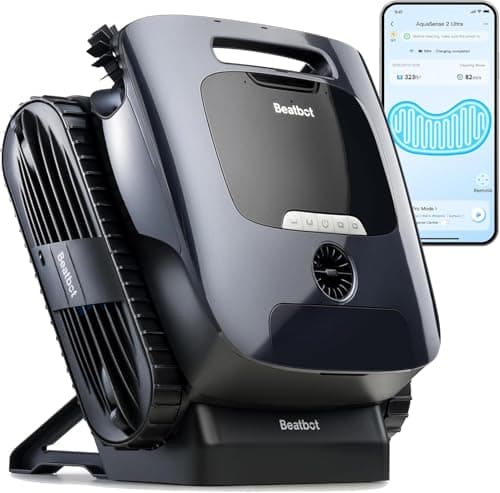
- Camera mapping with object or debris detection. The flagships. Builds a map, and in the Beatbot AquaSense 2 Ultra’s case detects where debris actually is and goes there. Genuinely earns its premium on freeform, multi-level and beach-entry pools, and earns nothing on a rectangle.
Ultrasonic and sonic avoidance (Beatbot’s SonicSense) sits between the second and third: it detects obstacles without building a map.
Power: cordless or corded
A corded machine runs low-voltage DC from a transformer on the deck — no battery, no runtime limit, a cable in the water. A cordless machine carries a lithium pack: no cable, a runtime limit, and a component that ages. This is the architecture decision, covered in full in cordless versus corded.
What it cannot do, mechanically
It cannot swallow rigid debris larger than its intake — acorns, cones, thick twigs jam it. It cannot clean steps reliably, because a step is a vertical face it has no reason to hold to. It cannot kill algae, because that is chemistry. And it cannot filter the whole pool volume continuously the way your main filter does; it filters the water it happens to move through itself.