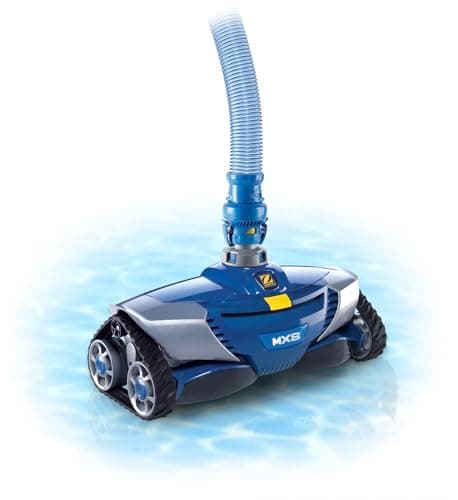
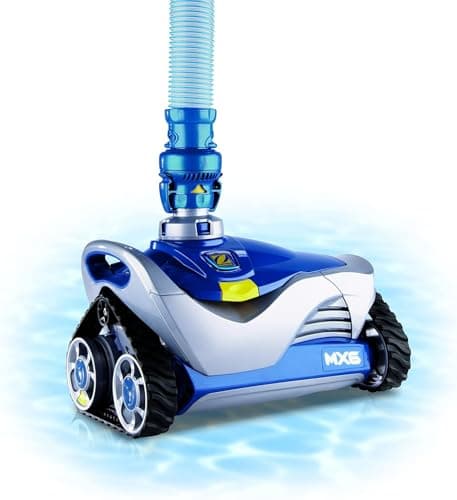
What Zodiac’s MX line is for
Automatic floor cleaning with nothing in it to fail. No motor, no circuit board, no battery, no transformer to site, no booster pump. It connects to your skimmer or a dedicated suction line and is driven entirely by the suction your pool pump already produces.
That architecture explains both the appeal and the limits, and the types-of-cleaners guide covers how the categories differ.
The two genuine engineering features
Cyclonic suction
Zodiac publishes cyclonic suction on both machines. The practical effect is that flow holds up better as debris accumulates in the line than with a simple straight-path design — which matters on a cleaner that is at the mercy of whatever flow your pump supplies.
X-Trax treads
Tread rather than wheels. Treads grip textured plaster and rough pebble well, which is a large part of why suction cleaners remain competitive on abrasive surfaces where robot brushes grind down in a single season — the pebble and gunite roundup makes that case. On slick fiberglass gelcoat, expect less.
MX6 or MX8
| MX6 | MX8 |
|---|
| Reach | Not published | 39 ft |
| Surfaces | Inground | Rated for all inground surfaces |
| Maneuverability | Exceptional in tight spaces | Good |
| Best for | Small and awkward pools | Mid-to-large pools, rough surfaces |
The MX6’s strength is maneuverability — it turns tightly and works into corners and odd geometry better than most machines of any type, which is why it is our pick in the small-pool roundup. The MX8 adds published 39-foot reach and explicit all-surface traction.
The trade, which applies to every suction cleaner
- Debris goes into your filter. Up the hose, into your pump basket, into your filter. More frequent backwashing or cartridge cleaning, and on a sand filter backwashing dumps treated water.
- Your pump runs throughout. Pool pumps are among the largest electrical loads in a home per the Department of Energy. A robot cleans with the pump off; this does not. That is where the real cost difference between the categories lives — not in the purchase price.
- No walls, no waterline, no filtration of its own. Fine silt and dead algae are beyond it entirely, since there is no micron rating to speak of.
- Needs sustained flow. On an undersized pump, or a variable-speed pump run low for efficiency, they move sluggishly or not at all.
The compensation: they do not break
No electronics, no battery, nothing holding water out of a motor housing. Fifteen-year service lives are normal and a complete refresh is a set of wear parts. Against a $400 cordless robot whose battery will likely need replacing in year three or four, that is a different kind of value proposition rather than an inferior one — the lifespan guide covers both sides.
Which Zodiac to buy, and when not to
- Small or awkwardly shaped pool, pump with flow to spare: MX6.
- Mid-to-large pool, rough pebble or gunite surface: MX8.
- Want water filtered, walls cleaned, or the pump kept off: buy a robot. For most buyers in 2026 that is the better machine, and we would say so — the master roundup has the field.