Pine needles deserve their own page because they fail machines in a way nothing else does. A leaf is large and soft: it either goes in or it does not. A grain of sand is small and round: a fine mesh stops it. A pine needle is thin, rigid, several inches long, and arrives in thousands. It defeats machines in three distinct ways at once.
The three ways pine needles beat a pool robot
1. They bridge the intake
Needles do not fold. A dozen of them lying across an intake mouth form a lattice that blocks it while the basket is still empty. The machine runs on with no suction, which reads as a motor fault and is actually a two-second clear-out.
2. They wrap rotating parts
Anything with an axle — brush rollers, wheels, tracks — accumulates a tight wrap of needles at the shaft ends. This is the mechanism behind most needle-related failures, and it progressively loads the drive motor. Check brush axles weekly during needle fall, not monthly.
3. They mat into the mesh
Needles pack into filter mesh at an angle and interlock, and unlike leaf litter they do not rinse out — they have to be picked out. A fine filter during needle season is a waste of a filter.
The strategy that works: catch them floating
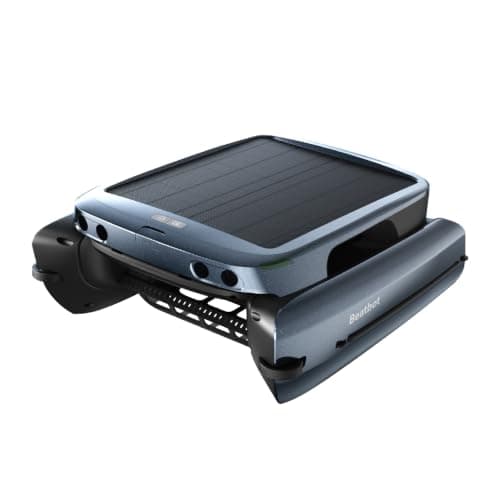
Everything above describes needles that have already sunk. Pine needles float for hours, and while they float they are in a thin layer on the surface where a skimmer can take them in bulk without any of the three problems above. This is why the Beatbot Sora 70 — which skims the surface and cleans the floor in the same cycle — tops this page rather than a machine with a better floor spec, and why a dedicated solar skimmer alongside any competent floor robot is the cost-effective version of the same approach.
The arithmetic is simple. A needle intercepted floating costs you a basket empty. A needle that sinks costs you a jam, a brush-axle clean, a matted filter and a stain. The skimmer roundup has the three worth owning.
Intake geometry over suction, again
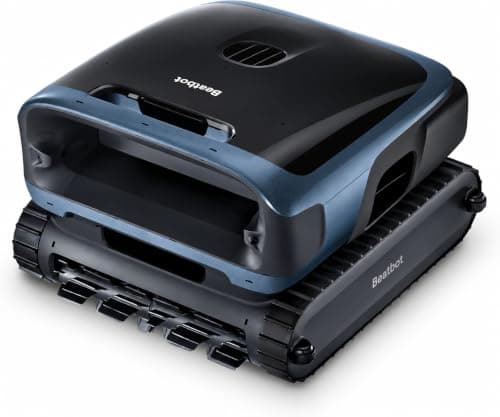
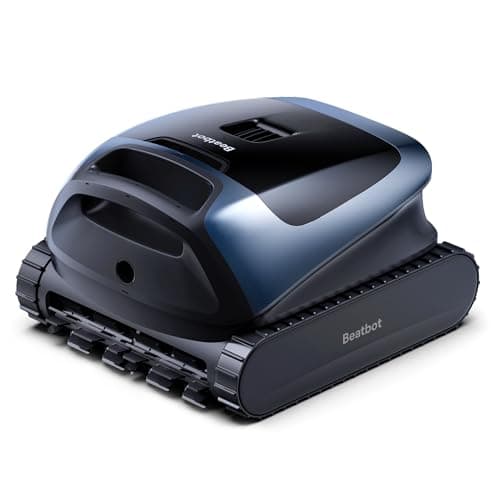
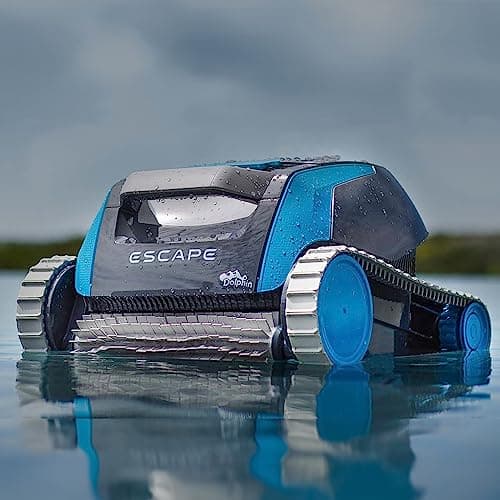
For the needles that do sink, you want a wide intake mouth and a short, straight path to the basket. The Beatbot Sora 30 and Dolphin Escape both have genuinely large top-loading debris bins and wide intakes, which is the right shape. A machine with a narrow throat and a fine pre-screen will jam regardless of its GPH figure.
Pressure-side is a legitimate answer here
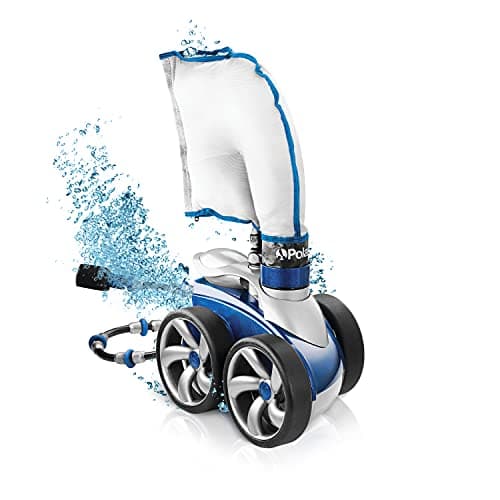
If your pool gets needles and cones, the Polaris 3900 Sport’s dual-chamber bag will take both and keep them out of your filter entirely. It needs a booster pump and it does not filter water, so it is a specific choice rather than a general one — but under a mature pine, it is a defensible one.
Maintenance schedule during needle fall
- Empty the basket after every cycle, wet.
- Check and clear brush axles and wheel shafts weekly.
- Use the coarse basket, not the fine one.
- Skim the surface before each run — thirty seconds with a rake saves the robot a lap.
- Watch for the robot getting stuck or stalling, which during needle season is nearly always a wrap or a bridge rather than a fault.