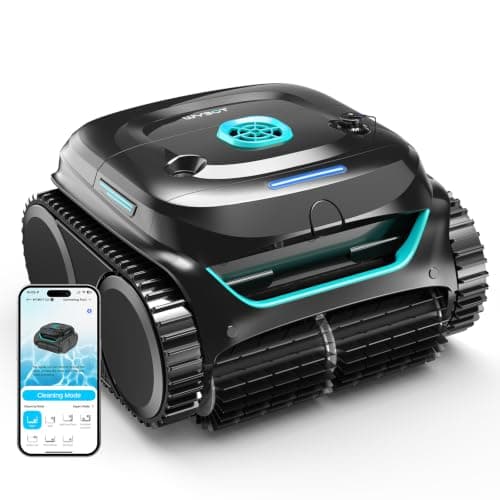
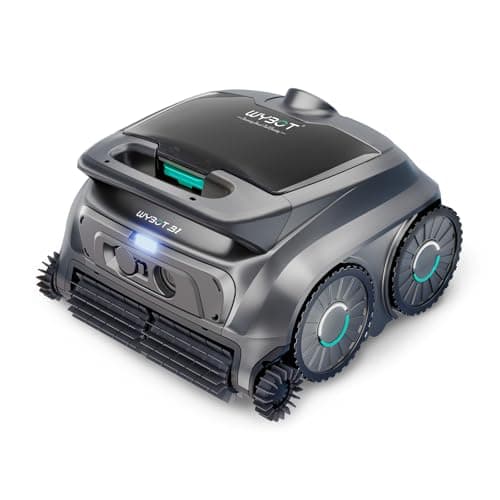
The B1 is WYBOT’s newest and cheapest machine here, and it is interesting for a reason that has nothing to do with suction numbers: it is designed around the part of the pool most robots do worst.
The cove is where your debris actually is
Walk around a pool that has just been cleaned by a competent robot and you will often find a continuous line of sediment where the floor meets the wall. That radius — the cove — is geometrically awkward: a flat brush on a flat chassis cannot conform to it, so the machine passes over the high points and leaves the valley loaded.
WYBOT’s answer is four roller brushes arranged for edge cleaning rather than one or two optimized for open floor. Whether that fully solves the cove is not something we can verify without testing it — and we do not test — but it is the right problem to be engineering against, and it is not a problem most machines at this price acknowledge at all. On an above-ground pool, where the cove is formed by cove material under the liner and collects almost everything, this matters a great deal.
High obstacle crossing
The other published claim worth having. A machine that strands on a main drain cover or a step return in a small pool has lost a meaningful fraction of its coverage, and in a dense small pool it meets those fixtures constantly. Stranding is the second most common complaint in this category, so a machine specified for it is addressing something real.
What is not published, and that is a lot
WYBOT describes the B1 as lightweight without giving a weight. It gives no micron figure, no rated pool area and no runtime. For a $335 machine that is more tolerable than it would be at $900, but it does mean the only things you can compare on paper are the brush arrangement, the obstacle claim and the price.
It is also WYBOT’s newest model, so owner-report depth is close to nonexistent. That is a genuine risk on a cordless machine, because the question that decides a cordless robot’s life — is a replacement battery sold? — has no answer yet for this one. Packs exist for the C1; verify before assuming.
Who it is for
A small-to-mid inground pool where the cove is visibly the problem, on a budget that stops well short of $500, from a buyer who does not need the waterline cleaned. For that person it is the most interesting $335 on this site. For anyone who wants published specs to compare, the C2 at $500 is the better-documented machine.
How we assessed it, and what we did not do
Every figure in the specification table on this page is attributed: to WYBOT’s published specifications, to the Amazon listing for this exact model, or marked as not published where neither source gives a figure. The score is derived from those published numbers by the five-metric rubric, which is published in full.
We have not physically tested this machine. We do not run a test pool, we do not own this unit, and nothing on this site claims otherwise. What we do instead is show where every number comes from, say plainly who the machine is wrong for, and refuse to print a figure we cannot source. Where owner reports inform a point, they are described as owner reports — never as our own experience.
Who should skip it
Skip the WYBOT B1 if you want the waterline cleaned or a published filtration figure — the C2 is $165 more and publishes 10 micron.
That is not a throwaway line. The most expensive mistake in this category is buying a capable machine that is wrong for your pool — and a machine rated below your pool’s area or missing the one capability your debris requires cannot be fixed by any setting.
Alternatives worth considering
- WYBOT C2 — publishes a 10-micron filter and 2,152 sq ft coverage, for about $165 more. Read the review
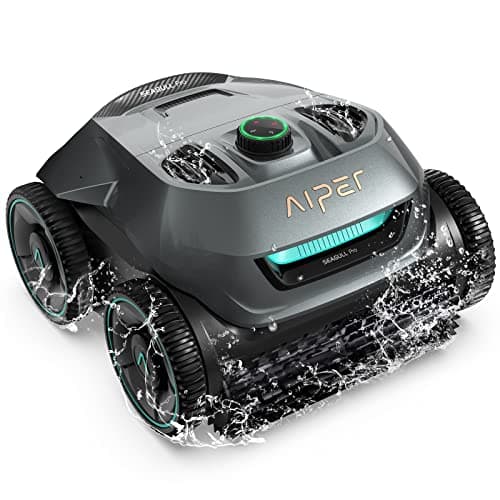
- Aiper Seagull Pro — publishes 150 minutes and 1,600 sq ft, with wall climbing, around $400. Read the review
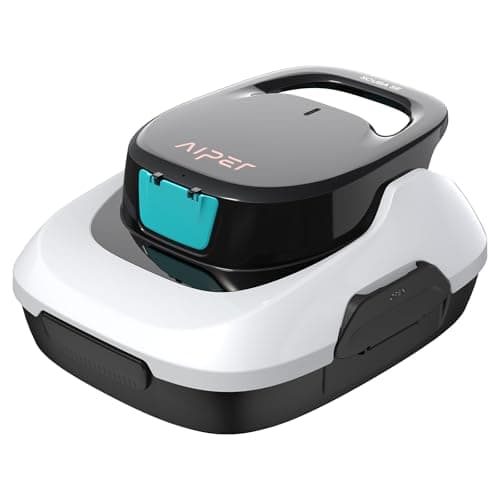
- Aiper Scuba SE — under $150 if floor-only in a small above-ground pool is genuinely enough. Read the review
If you are still narrowing down, the selector tool works from your pool type, size, surface and dominant debris, and the WYBOT brand guide covers the whole range and where it stops.